Nanjing AMADA Instrument Co., Ltd. · Nanjing, China [email protected] · +86-15195807515
Home Products Biological MicroscopeZoom Stereo MicroscopeFluorescence MicroscopeMetallurgical MicroscopePolarizing MicroscopeVideo Digital MicroscopeMicroscope CameraAstronomy AccessoryMicroscope AccessoryMagnifier Knowledge About Contact Request A Quote
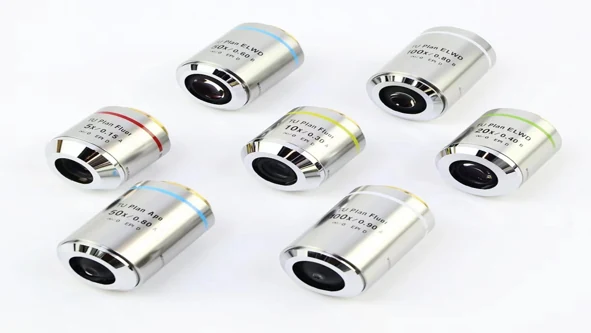
NIS 60mm Apochromatic Bright/Brightdark Metallographic Objective

NIS 60mm Apochromatic Bright/Brightdark Metallographic Objective

NIS 60mm Apochromatic Bright/Brightdark Metallographic Objectives are high-precision microscope objectives designed for metallurgical and materials inspection. The series includes 5X to 100X magnifications with apochromatic correction, offering sharp, flat-field imaging across a range of working distances and numerical apertures. Available in both brightfield and bright/darkfield configurations, they support detailed surface and microstructure analysis in industrial and research settings.

  • Apochromatic correction reduces chromatic and spherical aberrations for accurate color and edge definition
  • Brightfield and bright/darkfield modes allow flexible contrast control for different sample types
  • Consistent parfocal length across all magnifications enables quick switching without refocusing
  • Wide range of working distances and numerical apertures supports diverse sample geometries
  • Precise depth of focus and field of view values enable repeatable measurements and documentation

Technical features

  • Apochromatic design with chromatic and spherical aberration correction
  • Brightfield and bright/darkfield configurations available
  • Parfocal length 40 mm (5X–50X), 20 mm (50X–100X)
  • Working distance range from 1 mm to 23.5 mm depending on magnification and NA
  • Depth of focus from 0.48 mm to 4 mm across the series
  • Field of view from 0.25 mm to 31.27 mm, corresponding to eyepiece FOV
  • Mounting: 60 mm nosepiece with standard thread for compatibility with most metallographic microscopes
  • Numerical aperture range: 0.15 to 0.9, supporting oil and dry immersion options

Who it is for

  • Metallurgical labs in manufacturing and R&D departments
  • Quality control engineers in automotive, aerospace, and heavy machinery industries
  • Distributors supplying accessories for industrial microscopy systems
  • Research institutions conducting materials characterization

Specifications

ModelNIS 60mm Bright / Bright and Dark
Magnification5X, 10X, 20X, 50X, 100X
Numerical Aperture0.15, 0.3, 0.4, 0.6, 0.8, 0.9
Working Distance23.5 mm (5X), 19.5 mm (10X), 18 mm (20X), 11 mm (50X), 4.5 mm (100X, NA 0.8), 2 mm (100X, NA 0.9), 1 mm (100X, NA 0.9)
Parfocal Length40 mm (5X–50X), 20 mm (50X–100X)
Depth of Focus4 mm (5X), 2 mm (10X), 1 mm (20X), 0.61 mm (50X, NA 0.8), 0.5 mm (50X, NA 0.9), 0.48 mm (100X, NA 0.9)
Field of View31.27 mm (5X), 7.82 mm (10X), 3.5 mm (20X), 1.24 mm (50X, NA 0.6), 0.79 mm (50X, NA 0.8), 0.61 mm (100X, NA 0.8), 0.5 mm (100X, NA 0.9), 0.48 mm (100X, NA 0.9)
Mount Type60 mm nosepiece with standard thread
Illumination ModeBrightfield or Bright and Darkfield

Use guide

  • Select magnification and NA based on required resolution and working distance
  • Choose brightfield for general surface inspection, bright/darkfield for edge and defect detection
  • Verify nosepiece compatibility with existing microscope (60 mm standard)
  • Use parfocal length data to ensure smooth magnification switching without refocusing

FAQ

What is the working distance for the 100X objective?
1 mm (NA 0.9), 2 mm (NA 0.9), or 4.5 mm (NA 0.8) depending on the specific model
Can I use this objective with a standard metallographic microscope?
Yes, it uses a 60 mm nosepiece mount compatible with most industrial metallographic microscopes
What is the difference between Bright and Bright and Dark configurations?
Brightfield provides standard illumination; Bright and Dark includes darkfield capability for enhanced surface and edge contrast
Are these objectives parfocal?
Yes, parfocal length is 40 mm for 5X–50X and 20 mm for 50X–100X across the series
Do I need oil immersion for the 100X objectives?
Oil immersion is required for NA 0.9 models; dry operation is possible for NA 0.8 models but with reduced resolution

Related products